|
|
 |












|
RETURN TO: |
| Reviews: Books & Videos |
|
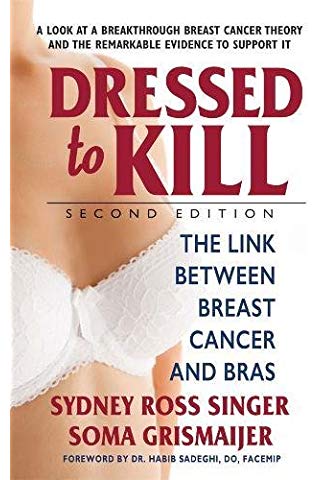
Books TITLE: "DRESSED
TO KILL - The Link
Between Breast Cancer and Bras"
This is also the book that lays out what is probably the most important message yet to be told regarding a possible major reduction of incidences of breast cancer that we face today. One in eight women in today's busy society will be diagnosed with breast cancer, should they live to the age of 95. Unless... unless they change the habits they have formed in how they dress. If they take off their bra, their chances of having breast cancer in their lifetime is more like one in one hundred twenty five, or about the same chance that a man has of being diagnosed with breast cancer (yes, men get breast cancer). This book follows the near tragic story of Ms. Grismaijer and Mr. Singer, man and wife, who faced the threat of her having radiation testing to learn the reason for lumps in her breasts. The real threat was to the unborn son she was carrying at the time. They made a well-informed decision to risk the consequences to her of not doing the radiation tests to preserve the life of their son. A blessed decision that was, because her breast lumps were benign cysts that left her breasts when she stopped wearing her bra. Blessed too is the world in that their son, Solomon, was born healthy and sound, and has become an amazing person with many wonderful accomplishments to his credit. This couple does not encourage one to ignore symptoms such as breast lumps, without medical training and experience to help one make the proper decision. Even with their medical training it was a risk they took to save a life, and as a result they developed an important medical break-through. These two researchers are Medical Anthropologists that hypothesized that Ms. Grismaijer was suffering not from malignant breast masses but likely benign fluid-filled cysts that were brought about by the prevention of lymphatic circulation within her breasts. This was due to the tightness of her bra, and also from the lack of natural lymphatic circulation due to the prevention of natural movement of her breasts, again, due to the wearing of a bra. They set up a major study in the early 1990s of over 4,700 women and their use (or non-use) of a bra, and they present their findings in this book. As of January, 2016, not one single study has been done to disprove the results of this study, and at least twelve other studies done in several countries have supported their findings. These results need to be accepted, so we can reduce the more than 50,000 women who die from breast cancer every year. The important message here is that YOU can make the choice without anyone telling you to make a change, especially if you read what these two researchers have learned. You can make the choice to remove that bra. This couple did a small follow-up study a few years later, in Fiji, where even more resounding results came out. Those results are described in the companion book "Get It Off! which I encourage you to order and read as well. Be sure to read Jeff Rockel's review of the first edition of this book on breast cancer by these authors by clicking on The Link Between Breast Cancer and Bras - A Review By Jeff Rockel . Click on this book icon below to learn more about this book. You may order it from Amazon, or you may search for other books, other products, ...any item that Amazon carries, and you will be dealing directly with Amazon. BE SURE TO ORDER THE SECOND EDITION... SAME INFORMATION WITH ADDED MATERIAL.
______________________________________________________________________________________________
This is a very simple book to read. It has a very simple message. Page one, line one reads: "Bra wearing is the leading cause of breast cancer." Period! How could that be stated more simply? Now, for the tough part: Will you accept that to be a fact? And perhaps even tougher: Will you act upon this information to possibly help yourself? The reader that wants to utilize the information that "Get It Off!" presents is expected to do a very simple maneuver: Take Off That Bra! (Gasp! You want me to do what?). This book clearly points out the authors' concerns and beliefs about how pressure from wearing the brassiere restricts the lymphatic system, and it points out how several studies have been done that support this hypothesis. There are no "medical" studies quoted in the book that show these results, because the medical profession does not appear to be interested in determining whether this simple theory could actually be true or not. No one wants to officially test this concept. Why not? Why do researchers and academic institutions not conduct studies to determine if bras actually cause cancer? Denial is the process by which we refuse to accept possible (maybe even obvious?) truths in our lives. Since Singer and Grismaijer brought us their ground breaking theories in "Dressed To Kill: The Link Between Breast Cancer and Bras" (I.S.C.D. Press P. O. Box 1880 Pahoa, Hawaii 96778, Copyright 1995, AISN: B005XDQOOU, there has been a lot of denial going on. I expected to see someone accept the authors' challenge, and conduct some studies to either support or refute the authors' theories by now, but none have come forth. Some studies have been done by the authors, themselves, both before and after their first book was finished. The positive data from their study of the Fijian women should be reason enough to encourage someone to accept the challenge to do further studies. The authors present some opinions of why "authorities" will not do the research. While we wait for those studies to get started, we are watching more than 195,000 women contract breast cancer every year in the United States, and more than 40,000 of them will not live to see their next New Year's Eve. If you want to stop and think about it, there will be another woman die in the next 13 minutes from breast cancer. Sydney and Soma really hope that you will become empowered with the information that they present in Get It Off!, and that it will prevent you from being one of those women. If the "experts" will not do the research that we need to see done, then we can do it ourselves. Right Now! Today! It will cost you nothing, it will cause no harm to you, it requires no chemicals or medicines or special diet. Simply take off that bra! If you are hesitant about doing that, read "Get It Off! " for encouragement and suggestions. Go to the authors' website at http://www.selfstudycenter.org for the most current information. How many people died before we finally accepted the truth about the connection between smoking tobacco and lung disease? Let us not let that happen with breast cancer, too. Buy the book! Read it! Get It Off! Click on the image below to go to Amazon where you can read about this book, or any other book or product, and you can order it or any other product as you would normally order from Amazon:
______________________________________________________________________________________________
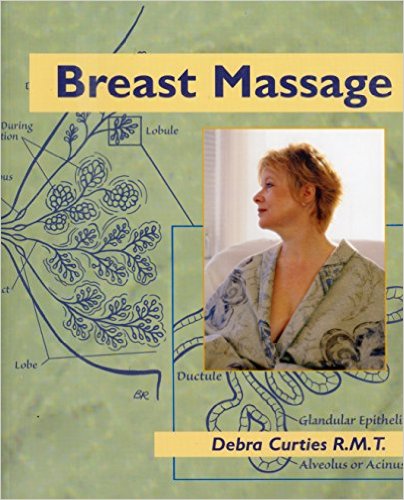
TITLE: Breast Massage We have supported the concept of breast massage since www.BreastNotes.com has been on-line, and this is a book that covers the issue very well. Written by Debra Curties, who has been a massage therapist and a Pathology and Clinical Theory educator for more than twenty years. In this book she addresses the objectives of doing breast massage therapy, and others have written in to tell their stories of how it has helped them in the past and continues to benefit them. Ms. Curties starts out with a good description of the anatomy and the function of the breast, to enable the reader to better understand the purpose, the benefits, and the technique of breast massage. Included is detailed information for women who are pregnant and/or lactating, and those experiencing breast involution starting as early as the second tri-mester of their lives. Why, indeed, would a woman have a breast massage? It is performed for reasons that are much more than just to feel better. As readers of this book, we become knowledgeable of the benefits we receive, and understand why it is that we feel better after proper breast massage. Clinical information about breast conditions (such as mastitis, abscesses, mastalgia, and breast implants) and issues, guidelines and decision-making that the professional massage therapists face daily is also presented. The author speaks directly to them in their own language. This is a professional book that the lay-person can understand. To get a more complete picture of what is happening, it may be somewhat helpful for you to pick up a simple reference book to learn where the specifically mentioned muscles are located. There are no muscles in the breasts, of course, but there are many in the chest area beneath and surrounding the breasts, and they perform active and important functions toward the natural circulation of blood and lymphatic fluid in the breasts. Specific details and techniques to guide the therapist through a complete breast massage is offered in words and images. There is also a similar section to help you with Breast Self-Massage. A special section is added into the book to describe the treatment of surgical scars through heat and massage. With breast surgery on the rise, many women suffer from the discomfort of adhesions and the poor cosmetic results of some surgeries. A complete section for references and a full bibliography is included as well. Do not let the publishing date be influential in your choosing to purchase this book. We have observed the price of this book escalate in the last few years, and that can only be due to the importance and value that the professionals that use the book have assigned to it. Click on the image below to go to Amazon where you can read about this book, or any other book or product, and you can order it or any other product as you would normally order from Amazon:
______________________________________________________________________________________________
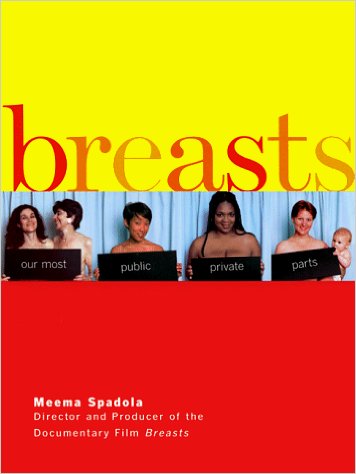
TITLE: Breasts: Our Most Public Private Parts Meema Spadola directed a lovely video called "Breasts: A Documentary", in which she interviews twenty two women that talk about 41 breasts. It is evident that the volume of information that she accumulated for that effort could never be told in 50 minutes, so she placed the bulk of that data into this book. Like the video, the book stands on its own accord, but I found that by viewing the video first, I was able to recognize some of the subjects in the book. The book contains no images, and being a visual learning person (so I have been told), I probably enjoyed them both much more this way. I cannot retrace my steps and do it the other way, but I am sure that I would have enjoyed the book with or without the video. I felt that the book presented the thoughts and feelings that a lot of women have about their own breasts. A 56 year old woman is quoted as saying: "…this is a chance to talk about something that no one wants to talk about with me". When I read the book, I saw "…women talking honestly with other women…". I hope no one minds if men listen too. I am not speaking about listening in a voyeuristic fashion, but I am sure that all men can learn a lot about "the other half of humanity" by listening to these ladies. The book's author views men and women as equals, and does not "blame" either sex for the other's troubles. Many books seem to find blame in others, about some strange things, and I feel that the issues at hand are clouded with emotions of a political or "gender" nature. We hear so much about breast size. The book heralds the idea that "What's important is not the actual size of our breasts, but how we feel about them." Doctor Loren Eskenazi, a plastic surgeon, said "Most women don't know what the range of normal breasts looks like. Unless you're a doctor and you've seen thousands of women with their shirts off, you don't know." The author stated that "The myth of the 'normal' breast was finally shattered for me when I began making the breasts documentary". She further states "Talking to hundreds of women and seeing so many real breasts made me feel better about mine - an experience that many viewers shared. Under the magnifying glass of this experience, my obsession crumbled." The author examines how women feel about their own breasts. Gennifer, a 48 year old woman from the Midwest said: "For my well being, I've come to realize its not my breasts that need changing, but my attitude about them." The author states that "Our breasts empower us when they send out a message that feels comfortable to us, but if we believe they're conveying the wrong message, they can make us feel defenseless." Sometimes, we go against the "normal" social expectations and do something "different". Breast ornamentation was talked about. Beth, a 25 year old with 38DD (38E) breasts felt that by adding a nipple ring allowed her to make an attitude change. "I think it's really my way of saying that I've spent more than a decade pretending I don't have boobs, and it's time to get over that and move on. "Bralessness was addressed as an attitudinal issue when the author stated: "There's something threatening and powerful about a braless woman - too much jiggling makes people a little nervous." Issues like breast augmentation and reduction, including implants, are talked about in the book. Also, breast development, breastfeeding, breast cancer, redefining one's sexuality, and aging are addressed. The part that sets this book apart from many of the others is that it is real women talking about real breasts - their own - and they are passionate about the subject, because they are so involved. The author sums it all up when she states that "If, instead of allowing breasts to be a taboo subject, we talk about our breasts - not just in relation to health issues, but in all areas of our lives - chances are, we will develop healthier attitudes. While there is no guarantee of healthy breasts, we would be more likely to take better care of ourselves, and better equipped to respect our bodies as they are." BreastNotes.com agrees with that last statement, and in many ways agrees with the entire book. We are proud to place Breasts: Our Most Public Private Parts on our "Recommended Reading" shelf. Click on the image below to go to Amazon where you can read about this book, or any other book or product, and you can order it or any other product as you would normally order from Amazon:
______________________________________________________________________________________________
TITLE: "TYRANNY OF THE BRA -
In Ten Studies - The New Evidence
This book is a treasure chest of research into
breast cancer. Here are some simple facts we have known for
twenty five years and are borne out by at least a dozen
international studies done in the last thirty years (two more
since this book was published) that are detailed in this book.
Does it sound to you like these simple facts bear out the claim that wearing a bra has no influence on the development of breast cancer?
American Cancer Society alone
collected over $9,000,000,000 of our money last year, and yet
they cannot find these facts to be a good enough reason to do
even one scientific study to see if there really is a connection
between the restriction of breast movement and resulting
accumulation of carcinogens in the breasts to cause breast
cancer to develop.
Until I can add in the special link that takes you straight to Amazon to purchase either the Kindle version or the paperback version, copy this: Tyranny of the Bra: In Ten Studies The New Evidence then return to the 'HOME' page of this website, drop down half way and click on the banner for Amazon, and when Amazon opens up, past the copied text into the search window.
|
||||||||||
 This is the book that started it all.
This is the book that caused the sensation that still rocks
the undergarment industry, and due to the major
medical financial contributions from that industry, it is
rocking the medical industry as well. It is also the
book that puts the fear of a major fashion change in the
minds of women world-wide.
This is the book that started it all.
This is the book that caused the sensation that still rocks
the undergarment industry, and due to the major
medical financial contributions from that industry, it is
rocking the medical industry as well. It is also the
book that puts the fear of a major fashion change in the
minds of women world-wide. 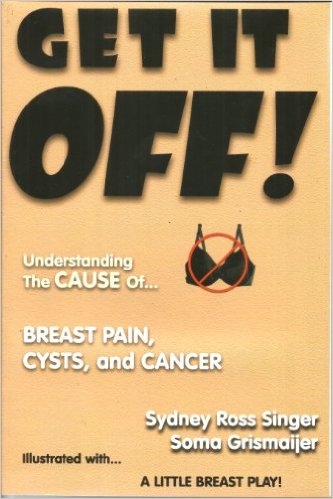
 Are
you concerned about breast cancer? At least one third of a
million women in the US alone will be... when they are diagnosed
next year with breast cancer. That is how many were affected
this year... and the previous year... and the year before that.
Sadly, cancer societies, manufacturers of bras and medical
devices, and a lot of medical diagnostic people count on those
women for a steady income and are hesitant to admit that there
can be a simple way of avoiding breast cancer. Cancer societies
would not admit that smoking cigarettes were implicated in lung
cancer... for a good thirty years. They had board members that
were involved in the tobacco industry. Is there a similar reason
for why they continue to deny bras affect breasts?
Are
you concerned about breast cancer? At least one third of a
million women in the US alone will be... when they are diagnosed
next year with breast cancer. That is how many were affected
this year... and the previous year... and the year before that.
Sadly, cancer societies, manufacturers of bras and medical
devices, and a lot of medical diagnostic people count on those
women for a steady income and are hesitant to admit that there
can be a simple way of avoiding breast cancer. Cancer societies
would not admit that smoking cigarettes were implicated in lung
cancer... for a good thirty years. They had board members that
were involved in the tobacco industry. Is there a similar reason
for why they continue to deny bras affect breasts?